


A man overboard is one of the most time-critical emergencies at sea. Survival depends on immediate recognition, decisive action, and a disciplined bridge response. For the Officer of the Watch, correct early actions are essential to maintain control and prevent loss of the casualty.
On witnessing or being informed of a man overboard, the priorities are always the same:
raise the alarm, maintain continuous visual contact, mark the position, and call the Master immediately.

Immediate Actions (OOW)
-
Shout “Man Overboard”
-
Release lifebuoy and flotation aids
-
Maintain continuous visual contact
-
Activate MOB marker on GPS / ECDIS
-
Call the Master and sound the alarm
-
Record time and position
These actions must be instinctive and immediate.

Purpose
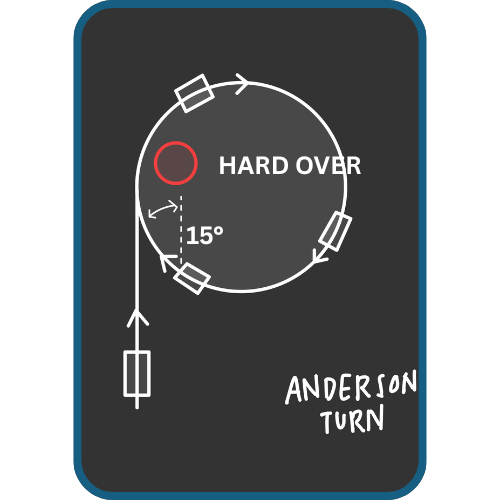
The Anderson Turn is designed for rapid recovery when the casualty is continuously visible.
Manoeuvre
-
Rudder hard over towards the side of the casualty
-
Maintain full helm until the vessel has turned approximately 250–270 degrees
-
Bring the vessel back directly towards the casualty
Advantages
-
Fastest recovery manoeuvre
-
Minimises time in the water
-
Simple execution when conditions are favourable
Limitations
-
Does not return the vessel to its original track
-
Unsuitable if sight of the casualty is lost
-
Requires decisive ship handling and space

Purpose
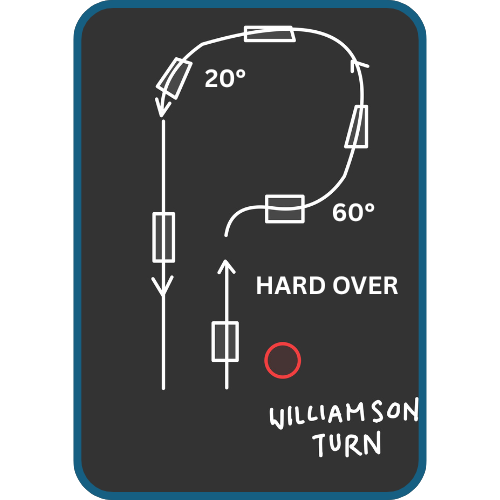
The Williamson Turn is intended to return the vessel to the original track, making it effective when the casualty’s position is uncertain.
When to Use
-
Casualty not continuously visible
-
Poor visibility or night-time
-
MOB position uncertain
-
Casualty detected shortly after passing the position
Manoeuvre
-
Rudder hard over towards the side of the casualty
-
When the vessel has altered course by approximately 60 degrees, rudder hard over to the opposite side
-
Steady the vessel on the reciprocal course
Advantages
-
Brings the vessel back along the original track
-
Effective when visibility is poor
-
Standard IMO-recognised manoeuvre
Limitations
-
Slower than the Anderson Turn
-
Larger turning circle
-
Greater time before recovery

Purpose
The Scharnow Turn is used when a man overboard is discovered late, after the vessel has already passed well beyond the casualty’s position.
When to Use
-
Significant delay before MOB is detected
-
Vessel has travelled far past the position
-
Casualty position known but behind the vessel
Manoeuvre
-
Rudder hard over away from the side of the casualty
-
After a large alteration of course, rudder hard over to the opposite side
-
Vessel returns to the reciprocal course
Advantages
-
Effective for late detection scenarios
-
Returns vessel back towards the casualty’s estimated position
Limitations
-
Slowest MOB manoeuvre
-
Rarely used in practice
-
Primarily examined for theoretical knowledge
